Euro Weeks
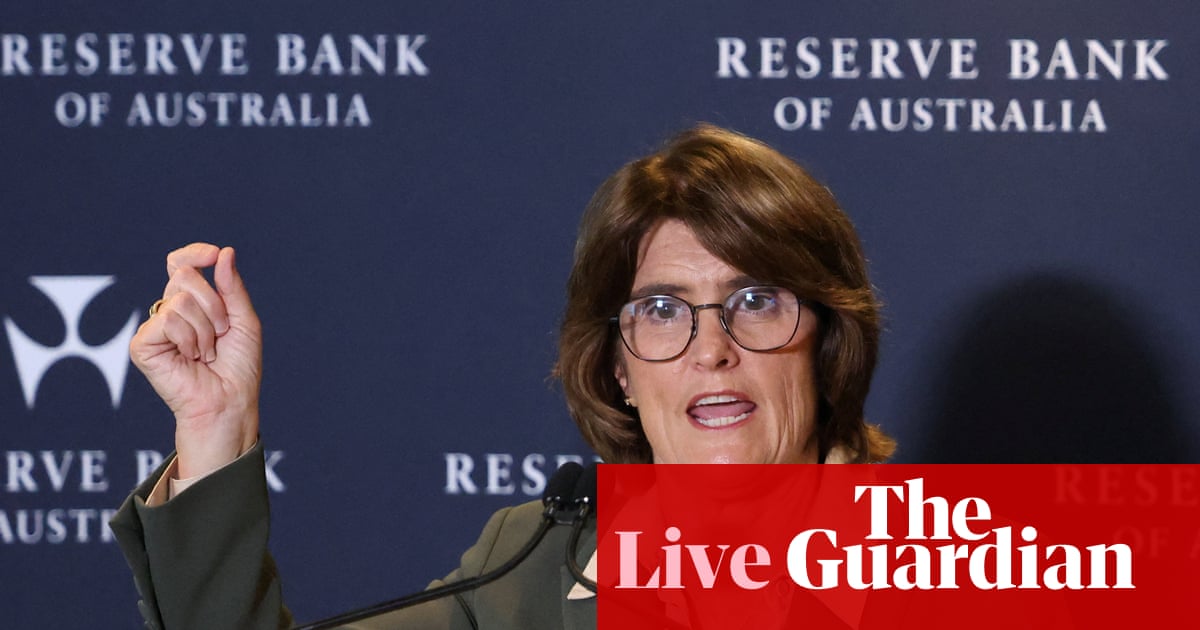
From 10m ago Bullock says she doesn’t see the ‘economy cracking at this point’ Jonathan Barrett Bullock says she doesn’t “see the economy cracking at this point” even though some people will feel like they are experiencing a recession. The decision to raise interest rates for a fifth time this year will face inevitable accusations the RBA is pushing the country into an economic downturn. Bullock pushes back against that framing: double quotation mark Our central forecasts do not see us going into recession, but it does see growth slowing quite markedly.
It shows that consumption is quite sluggish, and I think that is going to make people feel like it’s a recession because they feel poorer, their spending can’t grow very quickly because their incomes aren’t growing very quickly. Key events 10m ago Bullock says she doesn’t see the ‘economy cracking at this point’ 16m ago Australian share market ends higher after RBA rate hike 1h ago Michele Bullock addresses media following rate hike decision 2h ago Chalmers plays down role of federal budget on inflation 2h ago Chalmers says rate hike will be ‘difficult news’ for Australians already paying 'hefty price' 2h ago RBA board split on decision to raise cash rate 2h ago Reserve Bank raises interest rates to 4.85% 4h ago How would your mortgage change? 4h ago Chalmers says Australians bracing for 'difficult decision' 4h ago Welcome Bullock says she doesn’t see the ‘economy cracking at this point’ Jonathan Barrett Bullock says she doesn’t “see the economy cracking at this point” even though some people will feel like they are experiencing a recession. The decision to raise interest rates for a fifth time this year will face inevitable accusations the RBA is pushing the country into an economic downturn.
Bullock pushes back against that framing: double quotation mark Our central forecasts do not see us going into recession, but it does see growth slowing quite markedly. It shows that consumption is quite sluggish, and I think that is going to make people feel like it’s a recession because they feel poorer, their spending can’t grow very quickly because their incomes aren’t growing very quickly. Australian share market ends higher after RBA rate hike The Australian stock market ended higher after the central bank did what it was expected to do and hiked interest rates for the fifth time this calendar year.
The main S&P/ASX200 index rose 30.3 points, or 0.3%, to 8886.8, as the broader All Ordinaries gained 31.7 points, or 0.4%, to 9008.9. Most of the market’s 11 sectors were in the green, with the major materials and consumer stocks leading the way, while the energy sector carried most of the loss-makers. The Reserve Bank board ended its two-day meeting on monetary policy on Tuesday with a 25 basis point rise in the cash interest rate to 4.85%.
The Australian dollar was buying 69.77 US cents, down from 70.21 US cents at 5pm on Monday. – Australian Associated Press Photograph: Hollie Adams/Reuters Jonathan Barrett Bullock asked about effect of US-Israel war in Iran on interest rates Guardian Australia’s economics editor, Patrick Commins, asks Bullock whether the RBA would have raised rates if oil prices had stayed low. In other words, what would have happened had the US and Israel not launched strikes against Iran? Bullock gives a nuanced response, pointing out that Australia already had a problem with “excess demand” that required cooling. double quotation mark Now, would that have meant that we had to go up the same amount?
I don’t know the answer to that. It’s possible that it’s caused interest rates to mean they have to be a little bit higher. Bullock goes on to articulate an economic risk posed by raising inflation expectations caused by high oil prices: as consumers resign themselves to higher prices, businesses lift theirs ahead of anticipated rising costs, creating a self-fulfilling loop that entrenches inflation.
Jonathan Barrett RBA independence from government ‘a two-way street’, Bullock says Michele Bullock has described independence as a “two-way street”, noting that she doesn’t tell the government what to spend on, and that the government doesn’t tell the RBA what to do with rates. The role of public sector spending in fuelling inflation looms large, with Labor under pressure from critics over five rate hikes this year. Bullock says that governments need to decide on how much spending is required to provide for the nation.
She says: double quotation mark But that is for governments to decide. Independence is a two-way street. I don’t tell them what to do with fiscal policy.
They don’t tell me what to do with interest rates. Jonathan Barrett Unemployment and housing concerns behind board split: RBA governor More from Michele Bullock ’s press conference: The RBA decision to raise rates was split, with three members of the rate-setting board preferring a hold, while six voted to raise. Bullock says those in favour of a hold were concerned about risks to the economy, including rising unemployment and housing weakness.
Bullock said: double quotation mark They felt that there were potential downside risks in these circumstances, particularly since we’d already done four interest rate rises, and maybe we should wait a bit longer to get some more data to test that. Bullock says market watchers shouldn’t interpret the split decision as a sign the RBA won’t raise further if inflation risks materialise. Michele Bullock addresses media following rate hike decision Jonathan Barrett The RBA governor, Michele Bullock, says “this is not the news that many Australians want to hear, but it is what’s needed to get inflation down”.
She says “some pain now will prevent even worse pain down the track”. double quotation mark I understand that today’s decision is going to be difficult for Australians with mortgages, many of whom are already managing large repayments. But households with mortgages are not the only Australians doing it tough. Every household is dealing with higher prices for groceries, electricity, insurance, and other essentials.
High inflation is particularly painful for Australians on lower incomes, including people who rent and have little or no savings to fall back on. The comments were made in opening remarks to journalists in Sydney ahead of questions. Photograph: Jeremy Piper/Reuters Jonathan Barrett Economists intrepret RBA’s decision Several economists are interpreting the RBA’s statement accompanying the rate hike as “dovish”, which means further hikes are less likely.
UBS economists describe the decision as “clearly dovish” while Anthony Malouf , economist at Ebury, says there is an “absence of a clear tightening bias”. The Australian dollar also immediately dropped against its US counterpart after the decision, which shows traders do not believe the central bank is, at this stage, looking to hike much further. This could all change if inflation remains elevated, but for the moment, some economists and currency traders believe this could be the last hike, at least for a while.
Chalmers plays down role of federal budget on inflation Chalmers was asked about the federal budget and its impact on inflation. He said: double quotation mark Our budgets are not what’s putting upward pressure on inflation. But we can play a helpful role and that’s what we intend to do.
He was also asked if he’d consider stepping aside. “No,” the treasurer said. Chalmers says rate hike will be ‘difficult news’ for Australians already paying 'hefty price' Jim Chalmers , the treasurer, is speaking now after the RBA’s decision.
He said: double quotation mark Today’s decision was widely expected, but that doesn’t make it any easier for Australian families and businesses to absorb. It will be difficult news for many Australians who are already paying a hefty price for circumstances outside of their control. He pointed to the ongoing war in the Middle East as a major factor in inflation: double quotation mark The war’s in its ninth month and its re-escalation is putting sustained upward pressure on inflation.
It’s weighing on growth and its end can’t come soon enough for the global economy or for Australians facing cost of living pressures. Jim Chalmers. Photograph: Lukas Coch/AAP Macquarie Bank announces it will pass rate rise on Macquarie Bank has already announced it will pass on the interest rate rise to mortgage holders.
The bank said it will increase variable home loans by 0.25%, effective 19 November. It will also increase ongoing variable rates paid on its transactions and savings accounts by 0.25%, a boon to savers. Ben Perham , the head of personal banking, said: double quotation mark With household budgets already feeling the strain, today’s decision by the RBA will be challenging for many Australians.
To help our variable home loan customers prepare, we’re again waiting more than two weeks before this latest increase takes effect. Photograph: David Gray/Reuters The cash rate is now the highest it has been in 18 years A chart showing the cash rate RBA board split on decision to raise cash rate The decision was not a unanimous one: six members of the RBA board voted to raise the cash rate, while three voted to leave it unchanged. The RBA said in a media release: double quotation mark The Board is conscious of the period in which inflation has been too high.
Given the revised inflation outlook and the continuing upside risks, the Board judged that a further tightening in financial conditions is warranted to support the return of inflation to target. The Board will continue to do what it considers necessary to bring inflation sustainably back to target.
Source: The Guardian